A window onto the high hills
In a changing tourism economy, a photo book on Myagdi seeks to turn memory into marketable identity
Nepal’s tourism industry has long relied on Everest and the Annapurnas to do the heavy lifting. Now, a quieter corner of the Himalayas is trying to buy itself a place on the map—one photograph at a time.
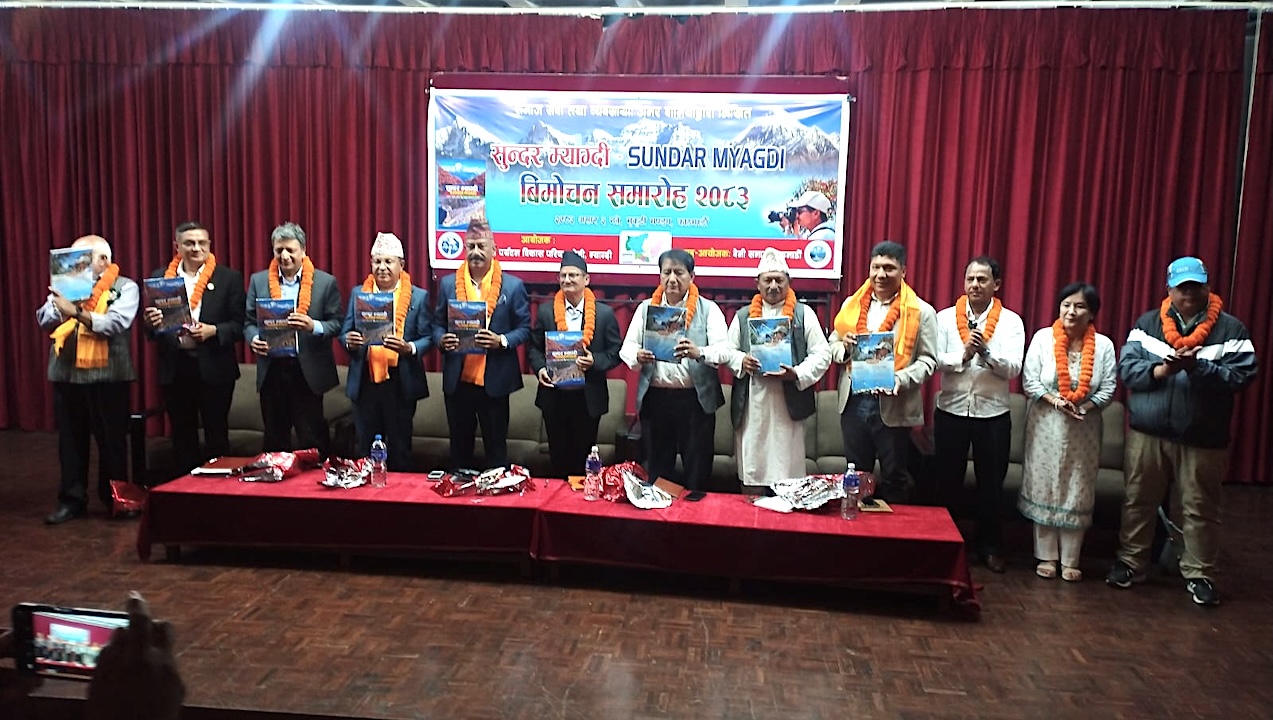
A new photo book, “Sundar Myagdi” (Beautiful Myagdi), launched this week in Kathmandu, offers a curated portrait of Myagdi district in western Nepal. Compiled by veteran journalist and photographer Amar Baniya, the volume blends four decades of field photography with a promotional narrative of landscapes, culture and daily life.
The launch, organised by the Dhaulagiri Tourism Development Council and Beni Samaj Kathmandu, was organised at the Nepal Tourism Board Hall, where the copies were unveiled by senior figures including former chief secretary Lokdarshan Regmi and FNCCI senior vice-president Surakrisna Baidya, alongside officials from the Nepal Tourism Board.
Myagdi, home to parts of the Dhaulagiri range and trekking corridors linking the Annapurna circuit, has often been overshadowed by better-marketed neighbours. Yet its proponents argue that it offers a distilled version of Nepal’s tourism appeal—fewer crowds, sharper peaks, and a denser layering of Gurung, Magar and Thakali cultural landscapes.
The book’s publisher frames it as both archive and advertisement. It documents trekking routes, biodiversity zones, homestays, festivals and heritage sites in a bilingual Nepali-English format, aimed at both domestic readers and foreign trekkers.
Baniya, who has spent much of his career documenting western Nepal from the district headquarters of Beni, the project is also personal. He describes the work as an attempt to “repay a debt to his homeland”—a sentiment often heard in Nepal’s growing class of diaspora returnees and provincial cultural entrepreneurs, who increasingly see tourism as both identity and income.
The rhetoric at the launch echoed this blend of sentiment and strategy. Speakers including Myagdi industry representative Rajesh Shakya, Beni community leader Narbahadur Baniya, and tourism journalist Amrit Bhadgaunle praised the book as a “reference point” for understanding Myagdi—language that sits somewhere between academic endorsement and marketing copy.
Nepal’s tourism sector, still recovering from pandemic-era disruption and facing intensifying climate risks in the Himalayas, has increasingly leaned on niche branding: homestays, “off-beat” trekking, and cultural immersion experiences.
Road access, accommodation capacity, and environmental management continue to lag behind the country’s tourism ambitions. Coffee-table books may draw attention, but they do not smooth mountain roads.
Still, there is a political economy embedded in such projects. By positioning Myagdi as both heritage and destination, publications like “Sundar Myagdi” reinforce a familiar Nepalese development model: culture first, capital second.
Whether travellers follow the imagery north-west from Kathmandu remains uncertain. But in Nepal’s increasingly competitive tourism narrative, being seen is already half the battle.


