Kathmandu climbing contest marks shift to more technical format
Third edition of Tenzing Norgay Sherpa Open introduces lead climbing for the first time, as Nepal seeks to grow its domestic sport climbing scene alongside Himalayan expeditions
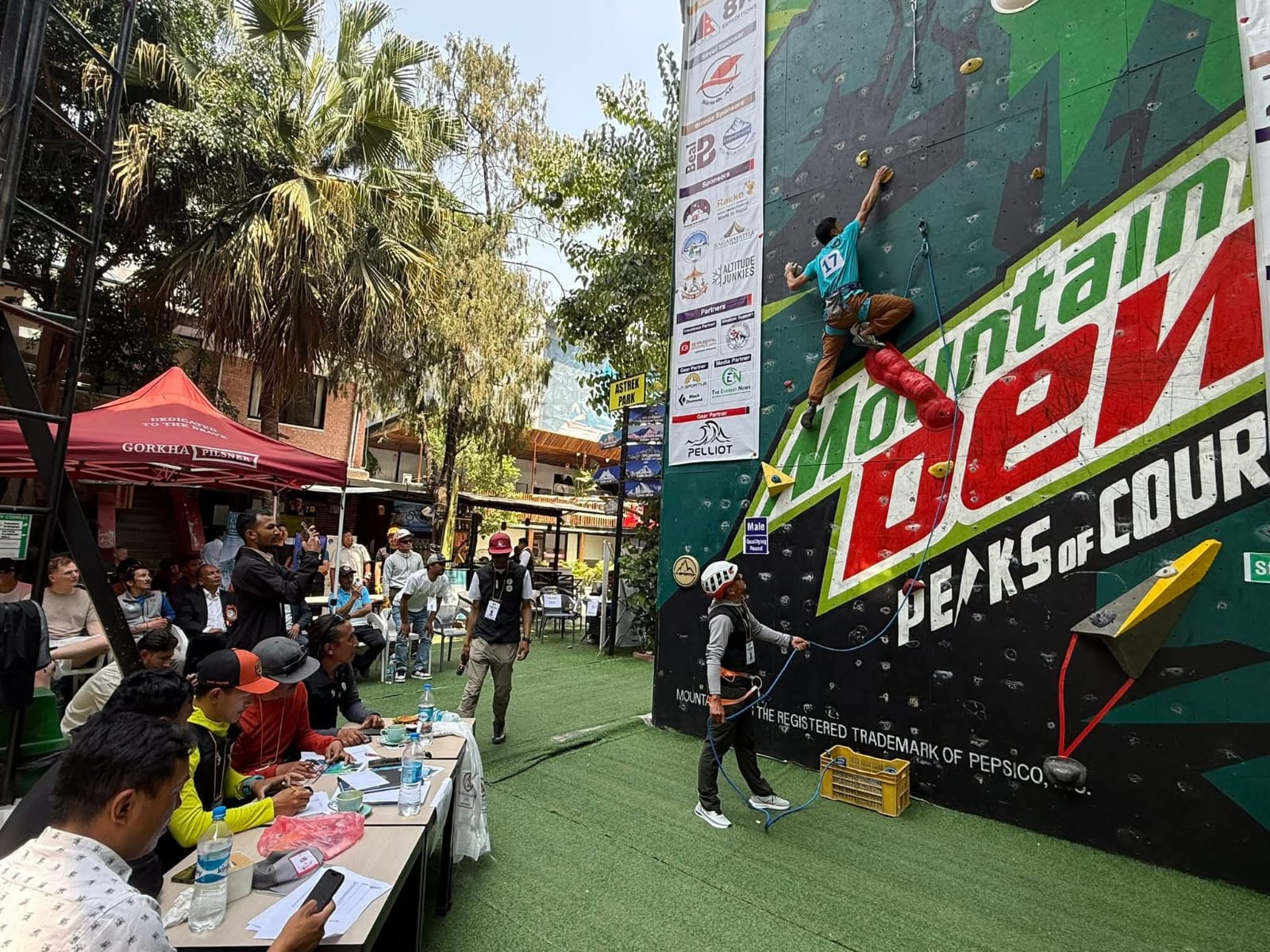
PC: Phurpa Sherpa
Kathmandu’s modest but growing sport-climbing scene received a symbolic boost this week as the third edition of the “Tenzing Norgay Sherpa Open Lead Climbing Competition” opened on Thursday in the capital, drawing Nepali and foreign climbers to one of the country’s few technical climbing contests.
Jointly organised by the Nepal National Mountain Guide Association (NNMGA) and the US Nepal Climbers Association Inc., the event seeks to promote competitive climbing in a country better known for Himalayan expeditions than indoor sport climbing.
The competition was inaugurated by Nepal Mountaineering Association president Fur Gelje Sherpa at the Astrek Climbing Wall in Thamel. Organisers said 38 climbers are participating this year, including 27 men and 11 women. One male and one female participant are foreign nationals.
This year’s edition marks a notable shift in format. For the first time, the competition is being conducted as a lead climbing event rather than a top-rope contest, a technically more demanding discipline that places greater emphasis on endurance, route-reading and risk management.
“This year’s competition is special because, for the first time, it is being held in the lead climbing category,” said Tul Singh Gurung, president of NNMGA. The previous two editions, he noted, were limited to top-rope climbing.
Organisers have scheduled the finals for May 29th, the anniversary of the first ascent of Mount Everest in 1953 by Tenzing Norgay Sherpa and Sir Edmund Hillary. Member of Parliament Mingma Gyabu Sherpa is expected to attend the closing event.
In Nepal, Everest Day has traditionally been marked by ceremonial rallies and commemorative programmes. Gurung said the organisers wanted instead to associate the anniversary with a more technical form of adventure sport.
“Technical sports events are rarely organised on this date,” he said, arguing that the competition could contribute to the development of Nepal’s climbing sector beyond commercial mountaineering.
Prize money remains modest by international standards. Winners in the men’s and women’s categories will receive NPR 50,000 for first place, NPR 30,000 for second and NPR 20,000 for third.
The competition reflects a broader ambition within Nepal’s climbing community: to nurture a domestic culture of sport climbing alongside the country’s lucrative high-altitude expedition industry.