“I nearly turned back — then I saw him”
Guide Ashok Lama, who carried out a dramatic Everest rescue at over 7,500 meters last spring, recalls how he once again waded into rescue effort alone and saved a Nepali guide stranded above Camp IV on Mount Annapurna.
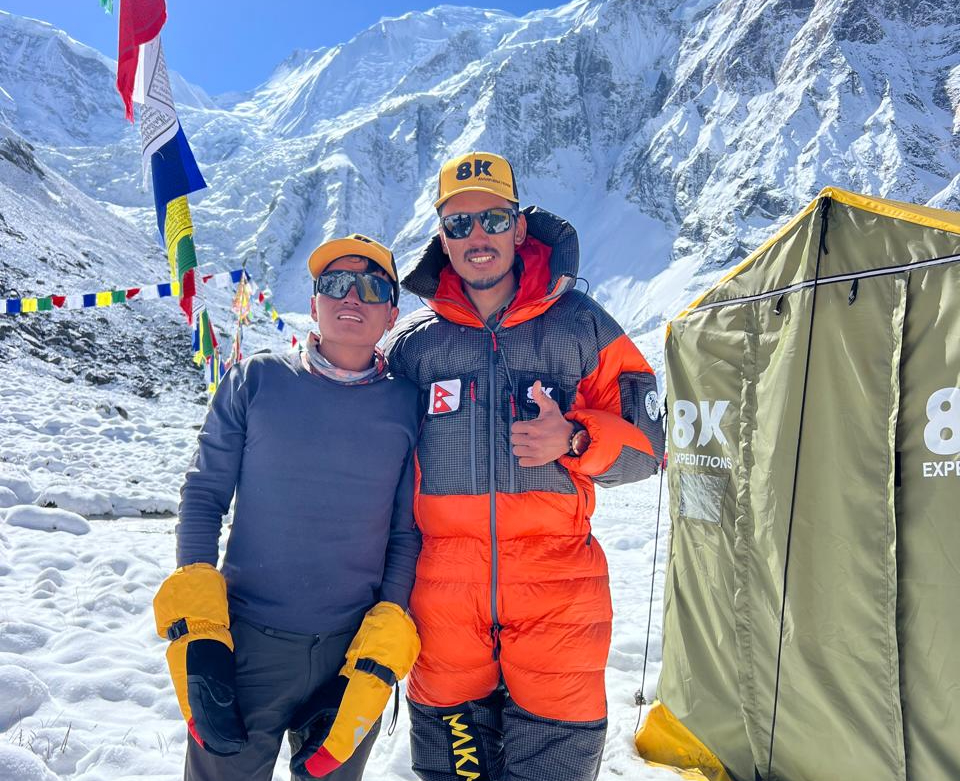
PC: Photo: Ashok Lama
I summited Mount Annapurna (8,091m) on the morning of April 18, 2026, around 10:15am Nepali time with my client. We then descended down to Camp III and rested, as is routine after a successful summit.
While we were descending, Dawa Nurbu Sherpa had just arrived at Camp III with his client, the Swiss IFMGA guide Richard Markus Bolt, headed towards the summit. They were the last team to go for summit. They successfully summitted Annapurna on April 19, the only team to do so on that day.
When we had passed each other in camp III, us going down and them going up, everything seemed normal. But it was not to be. On the mountains, danger rarely announces itself.
As we were descending towards camp II on April 19, I received a radio call. It was Dawa Nurbu. He said that he had lost the route. He sounded uncertain and vague. At that altitude, confusion can come quickly; I suspected he might already be hallucinating.
Just below Annapurna top, there is a gorge that gives way to a flat traverse. Camp IV is located in this traverse. Dawa had apparently mistaken Camp IV for Camp III and so made a wrong turn. He should have been heading down to camp III via a mostly flat route but instead turned the opposite way. We didn’t know of this until much later.
Dawa’s client Markus had descended ahead of him and Dawa was alone. He told me he had reached the couloir on camp III but there was no rope. I thought perhaps the rope had been swept away by an avalanche. I told him to climb back up, retrieve rope from above, as there were no more teams that would be summitting, and fix it for his descent.
He came back on the radio: there was no rope above him either.
I was still climbing down, helping another climber, Marie Saame of Estonia, who had attempted the mountain without bottled oxygen. By the time we reached Camp I, at around 4pm, Dawa sounded more frightened. I had switched my radio off to conserve battery. When I turned it back on, his voice had changed -he sounded very strained and disoriented.
But I could not turn around yet. I had two climbers to get down safely.
We continued to base camp, arriving at around 1:30am on April 20. I decided I would go back up at first light. I went to sleep at 2am for a brief spell.
We began the rescue at dawn.
A helicopter arrived at base camp at around 5:30am with which we first did an aerial search. From above, I spotted what looked like a human figure between Camp III and Camp IV. The pilot saw it too. We agreed it had to be him.
I prepared immediately and was dropped at Camp III.
I climbed towards the figure, but it turned out to be a stone.
I pushed on to Camp IV. After some time, I heard his radio crackle faintly. He could barely speak. The helicopter noise must have woken him. He kept asking when I would reach him and whether the helicopter would come, but he was not fully conscious. He would just blabber on, talking to himself.
I called another climber Lakpa Sherpa, known as Makalu Lakpa, and asked for help. He flew over again and reported a figure above Camp IV. Makalu Lakpa said that they had spotted Dawa just above a tent in Camp IV which a climber, Stefi Troguet, had set up earlier.
I climbed towards that point. But I didn’t find Dawa.
By this point, I was on breaking point myself. I had not eaten for hours. I had barely slept. My oxygen was running low. I began to think I would have to turn back.
Then I looked up towards the summit as a final goodbye.
But then I saw a human figure. High above me, perhaps 400 metres by rope measurement above Camp IV, I saw him: a lone figure, seemingly still trying to climb down the slope. I gathered my strength and pushed on to reach him. It took me almost an hour to reach where he was, a distance that seems like a finger wide but takes herculean effort and time high above in the thin air.
I finally reached Dawa at around 11am.
He was not fully present. He spoke as if he were still climbing the summit, talking to himself, warning invisible companions. “We are near the summit,” he said. “Don’t go ahead. I am scared.” He would not answer me directly.
This behaviour scared me too.
I gave him oxygen immediately, along with juice and an apple, and allowed him a brief nap. Slowly, he began to regain consciousness. His legs were strong enough to walk, but his hands were frostbitten.
We descended together to Camp III, reaching there at around 2:30pm.
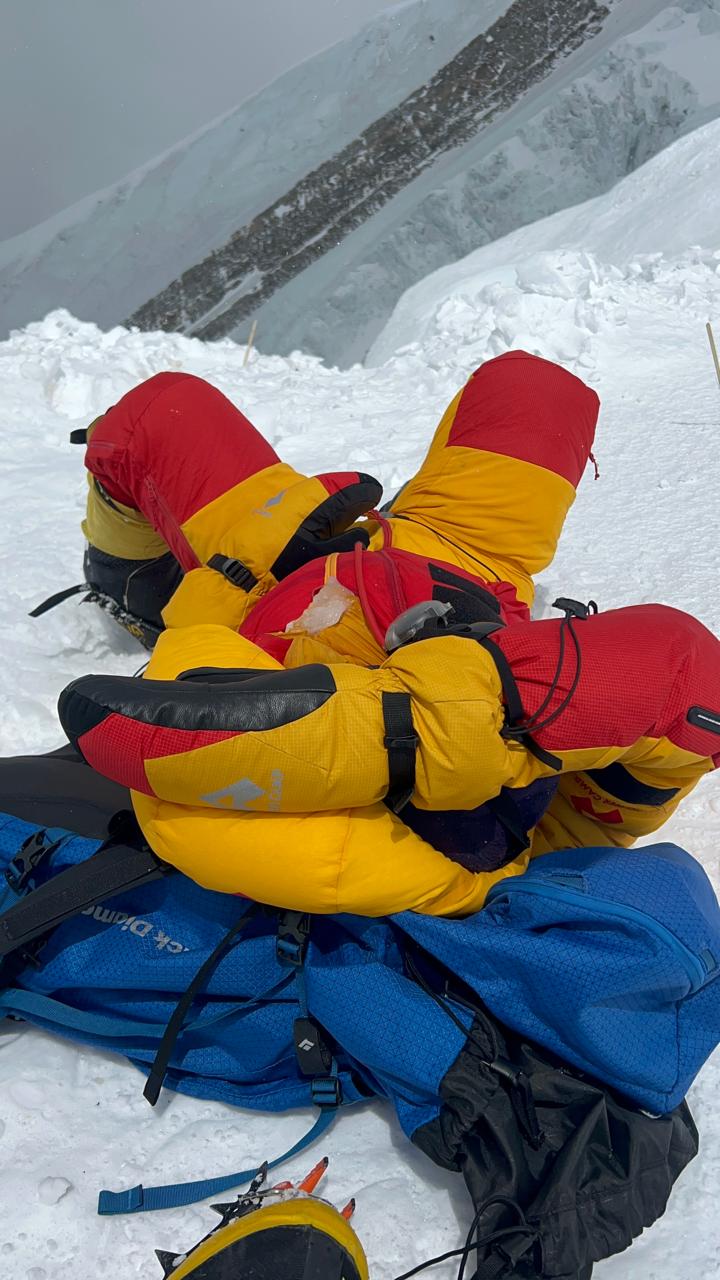
By then the weather had closed in. Snow began to fall heavily. The wind picked up. Helicopters could not land. We were forced to stay the night at altitude.
It was a long, cold vigil. I wrapped him in polyethylene foam to keep him warm. The wind was so loud I could not sleep. Snow kept building outside our tent.
By morning, nearly four feet of snow had fallen.
Before any rescue could land, I had to dig out the helipad myself. It took nearly an hour.
At around 7:30am, a helicopter managed to reach us and evacuate Dawa to base camp. It could not return immediately for me. For a time, I thought I might be stranded there another night, with little food and not enough clothing to keep warm.
Eventually, the helicopter came back and landed on the second attempt. The pilot — Priya Adhikari — told me she had only made the landing because it was me.
It was a narrow escape for both of us.
Looking back, I know how close it was. I had already begun to climb down when an instinct had made me turn back one last time. If I had taken a few more steps down, I would not have looked up. Or even if I did, I would not have seen him. He might have seen me, but he was too disoriented to call me or give me any signal. Dawa might have been lost in the slope forever.
When I found him, he was talking to himself, lost somewhere between ascent and descent, between reality and memory. He came back to his senses after he received oxygen. That is the difference a small intervention can make at 7,500 metres.
It was luck, in the end. Luck that I looked up. Luck that he was still moving. Luck that the helicopter could return.
Not every climber on Annapurna is so fortunate.
Rescues like this depend on resources — helicopters, coordination, funding. Large expedition companies can manage such operations. Smaller ones cannot. In many cases, a lost climber would simply be left where he is.
This time, he was not.
As told to Dewan Rai.
Ashok Lama is an IFMGA-certified guide with nine ascents of 8,000-meter peaks, including experience as a leader of a rope-fixing team on Mount Everest.