EU backs Nepal's aviation safety reforms as blacklist review looms
Regional training programmes in Kathmandu underscore European support for efforts to improve oversight standards and remove a 13-year ban on Nepali airlines
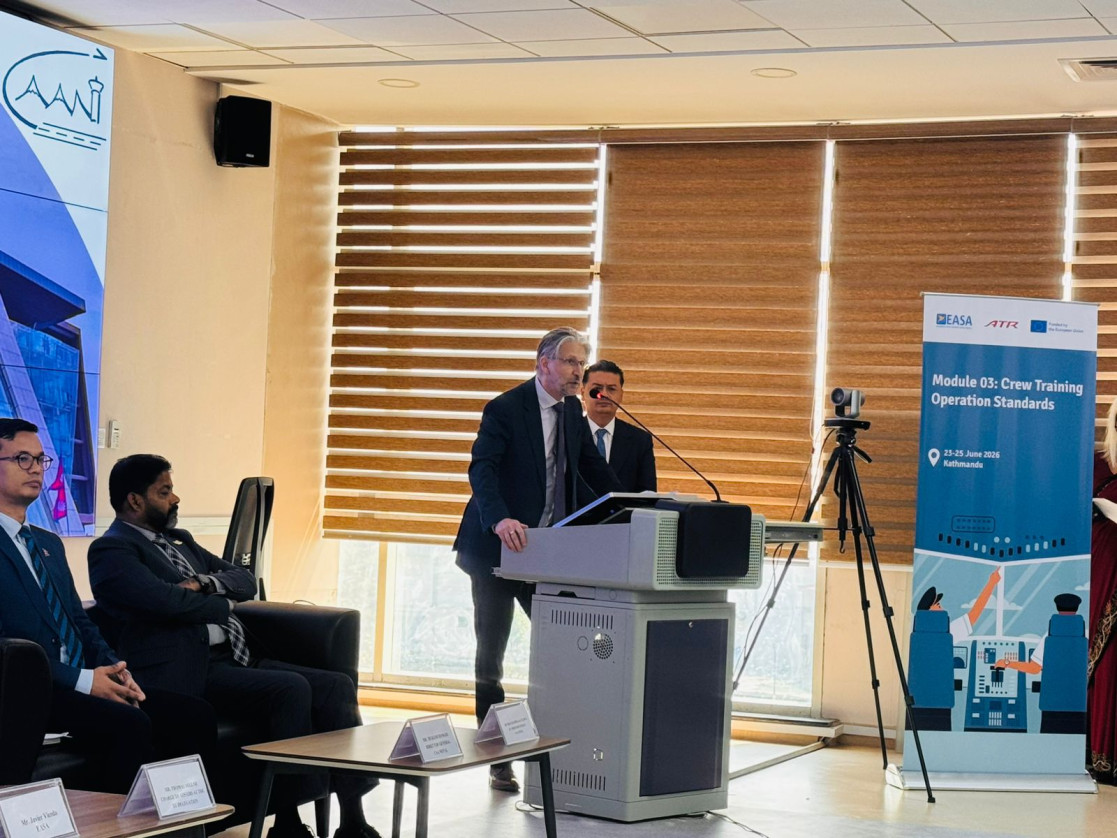
Mr Thomas Millar, Chargé d’Affaires at the EU Delegation, addresses the opening event of the Regional Aviation Safety Programme (RASP) on 23 June.
PC: EEAS
The European Union has launched a new round of aviation safety cooperation with Nepal, backing the Himalayan nation's efforts to improve oversight standards and secure removal from a longstanding European flight ban.
Aviation regulators, airline executives and technical experts from across South Asia have gathered in Kathmandu for a series of regional programmes under the EU–South Asia Aviation Partnership Project aimed at strengthening aviation safety and regulatory capacity.
The latest initiative began on Tuesday when Nepal's Civil Aviation Authority (CAAN) and European aircraft manufacturer ATR jointly hosted the third module of the Regional Aviation Safety Programme.
The training focuses on crew training and operational standards, including pilot decision-making, fatigue management and operational resilience.
Speaking at the opening ceremony, Thomas Millar, chargé d'affaires at the European Union Delegation to Nepal, welcomed recent government efforts to address safety concerns that have kept Nepali airlines barred from European skies for more than a decade.
"Air safety is clearly a priority for the Government of Nepal," Millar said, noting that Kathmandu had recently submitted documentation on the implementation of its corrective action plan to European authorities for review.
"The European Union and its Member States are keen to continue working side by side with the Government of Nepal to help achieve the level of safety that Nepali citizens and travellers deserve," he added.
Nepal has been on the European Union Air Safety List since December 2013, preventing all airlines certified by CAAN from operating in European airspace.
The restriction followed concerns raised by the International Civil Aviation Organization (ICAO) over shortcomings in Nepal's aviation oversight system. Although ICAO removed Nepal from its list of significant safety concerns in 2017, the European Commission has maintained the ban, saying further institutional reforms are needed.
A key EU demand is the separation of CAAN's regulatory and service-provider functions, a reform successive governments have struggled to implement.
In his budget speech last month, Finance Minister Swarnim Wagle pledged to split the aviation authority into separate regulatory and operational bodies by mid-January 2027, a move officials hope will strengthen Nepal's case for removal from the blacklist.
The aviation sector remains politically sensitive in Nepal, where difficult terrain, rapidly changing weather and infrastructure constraints have contributed to a poor safety record. According to government figures, the country has recorded 24 air crashes and more than 900 fatalities since 2000.
Organisers said a second EU-backed programme will be held in Kathmandu from June 29 to July 2, bringing together aviation regulators from across South Asia for a workshop on continuing airworthiness and recent regulatory developments under the European Union Aviation Safety Agency (EASA).
The workshop will examine evolving international safety requirements and modern oversight practices, helping authorities and airlines adapt to changing global standards.
European officials said the initiatives marked a shift from one-off technical assistance projects towards a more structured framework for long-term regional cooperation, while reinforcing Nepal's growing role as a regional platform for aviation dialogue.


