Climate promises, familiar script on World Environment Day in Nepal
From clean energy to green economy ambitions, officials reiterate commitments as pressure mounts to move from policy to practice.
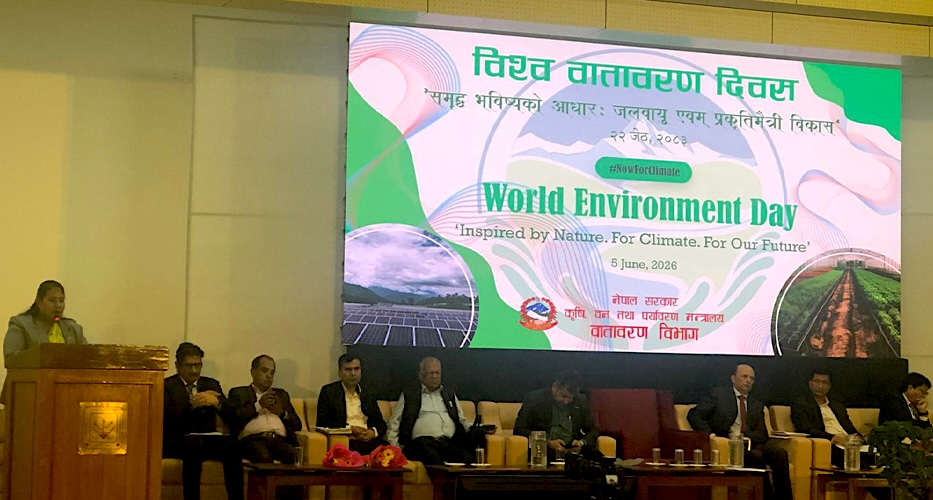
Nepal marked World Environment Day on Friday with the familiar choreography of pledges, speeches and warnings—this year framed under the theme “Climate and Nature-Friendly Development: Foundation of a Prosperous Future.”
In Lalitpur, the Department of Environment convened the main ceremony, bringing together officials, development partners and environmental experts under the gaze of government commitments that have become increasingly climate-literate, if not yet climate-proof.
The country’s top leadership struck a consistent tone. President Ramchandra Paudel urged citizens to adopt nature-friendly lifestyles, arguing that development and environmental protection must advance in tandem. He called for wider use of clean energy, tree plantation and stronger adaptation measures as Nepal confronts intensifying climate risks.
Vice President Ramsahay Prasad Yadav went further, warning that climate change, pollution and biodiversity loss are already landing hardest on farmers, rural communities and other vulnerable groups—those least responsible for the emissions driving the crisis.
At the centre of the main programme, Minister for Agriculture, Forest and Environment Gita Chaudhary said Nepal is attempting to pursue climate action alongside economic growth, despite contributing little to global emissions. She pointed to visible climate impacts “from the Himalayas to the Tarai” and outlined a policy direction anchored in a “green economy”: expanded climate finance, forest conservation, renewable energy, sustainable agriculture and biodiversity protection.
Her remarks reflected a familiar policy shift in Kathmandu—from reacting to disasters towards anticipating them. She stressed climate-resilient infrastructure, improved environmental planning, and value addition in medicinal herbs and non-timber forest products as a route to “green prosperity”.
Officials also highlighted expanding technical capacity, including air quality monitoring stations in 30 locations and the preparation of national and Kathmandu Valley air quality management plans. The Department of Environment, they said, will play a central role in implementing Nepal’s third Nationally Determined Contribution and strengthening environmental data systems.
The United Nations, in its global message for the day, warned of accelerating climate disruption—from glacier loss to heatwaves and wildfires—describing the moment as a “global call for climate action”.
What is striking is that none of the participants at the ceremony, including the President in his statement, referred in any meaningful way to the impacts of climate change unfolding in Nepal’s snow-capped mountains. Around 15% of the country’s territory is mountainous.
As the spring Everest expedition season ended, social media has been filled with images and videos of melting ice around Everest and other peaks, posted by climbers and guides. Mountain guides have raised concerns about deteriorating snow conditions and route instability, while scientists point to accelerating permafrost thaw across the Himalaya.
Yet these developments remain largely absent from official discourse. Policymakers instead tend to repeat familiar pledges on climate action each year, lending the occasion a sense of ritual rather than urgency.


